What Is a Portrait Photography Portfolio?
An ideal portrait photography portfolio will be strategically selected from your overall body of work and will convey the artist's/photographer's technical skill, creative vision, and ability to make a connection with their subject(s).
But, why does it matter? Well, because it gives potential clients or galleries an opportunity to experience the photographer's ability to establish "the illusion of permanence" in a single photograph. Ultimately, it is the most effective tool you have to build trust with potential clients and to prove that you can consistently capture the intangible qualities of a person.
Portfolio Curation & Organization: The Invisible Museum
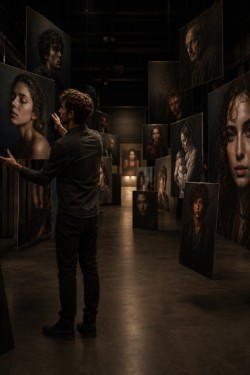
A photographers' organization process can reflect an institutional critique of their artwork. Curation is essentially making decisions on what not to show. Here are two factors artists need to take into consideration when curating their portfolio:
- Story Selection: Photographers need to evaluate what they intend to do with their images. They must choose the images that visually communicate the story they are trying to tell.
- Narrative Flow: A well-organized portfolio should flow like a narrative and allow the viewer to walk through the photographer's world of images. Each image should build upon the last.
General vs. Specific Portrait Photography Portfolios
The main difference between a general photography portfolio and a specific portrait photography portfolio is the degree of humanistic narrative. A general photography portfolio may include many different types of skills (i.e., landscape, still-life, etc.) while a portrait photography portfolio will focus exclusively on the performance of the human figure.
A portrait photography portfolio will focus on creating a deep psychological sense of understanding of both the photographer and the subject, as well as an emphasis on collaboration rather than simply providing technical diversity.
Creating Consistency in Your Photographs
Creating consistency throughout all photographs within your portfolio, is referred to as having a "Gallery Patina". By creating consistent compositions and styles, it allows you to create a visual identification with each photograph, allowing viewers to quickly identify your body of work. To create consistency in your work, you need to consider these two factors:
- Stylistic Intent: Consistency in the stylistic intent of your photographs, whether using dramatic lighting as seen in European paintings, or a light-filled and airy feel from the French Tradition of photography, makes the overall theme of your portfolio identifiable.
- Compositional Logic: Consistency of compositional elements such as framing and lighting make the viewer able to recognize the logic and/or reasoning behind your view of the world, giving the impression that the images were created intentionally versus randomly.
Using Themed Series
While creating a recognizable portfolio of your own work is beneficial, one method used to achieve recognition is to transition from shooting individual one-off images, to shooting thematic series. Each of these thematic series are temporary museums/installations; focusing on a specific social issue, environmental concern, or artistic perspective.
Thematic series allow photographers to focus on a single concept/idea for an extended period of time. This provides both intellectual stimulation for yourself and others viewing your work, while also increasing memory retention of your imagery.
Example of a thematic series could include a photographic study on the effects of aging or capturing portraits of people living within a particular urban area/environmental context.
Digital Versus Print
With advancements in technology, there have been numerous changes in how artists present their works, including the ability to create portfolios in either digital formats or print format. Both options have their own set of advantages/disadvantages.
Digital Portfolio
The option of sharing your photography digitally has several benefits. With a digital portfolio, your images can be accessed anywhere at anytime and shared around the globe instantly via streaming media/webcam. Additionally, because digital portfolios don’t require the physical hardware associated with printing images, they are generally less costly to produce/update.
Although there are many positive aspects associated with digital portfolios, some disadvantages exist. One potential disadvantage includes digital files lacking the tangible quality of prints. Another possible drawback is that once a file becomes damaged/lost/corrupted/etc., the data cannot be recovered/reproduced.
Print Portfolio
Printed books offer an entirely different experience compared to viewing an artist's work online. When experiencing a printed book containing an artist’s work, art enthusiasts are removed from the digital “hardware issues” associated with accessing digital images. In addition to being free from hardware-related problems, art collectors can connect physically with the artwork contained in printed books.
Although printed portfolios are typically more expensive than digital portfolios and require greater updates, they possess an element of authenticity/permanence that digital portfolios generally lack.
Ultimately, regardless of what path an artist chooses to create their portfolio; ultimately, the success of that artist depends on collaborating among themselves, the tools chosen to display their work and the audience which they want to appeal to.