The Photo Book as a Tool of One’s Career
An artist’s photo book is a definitive cultural document of the artists’ work at a given time in history. While a digital portfolio is generally seen as functional in order to generate clients, a book is considered performance as an exhibition. It takes the photographer from being a service provider to becoming the author of their own body of work and provides a tangible archive of their contributions to the field. A book also affords the photographer an opportunity to think beyond the confines of a traditional museum setting and to create a portable institution of their own making.
Comparing Digital Portfolios to Print Books
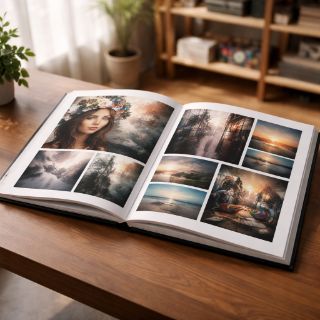
When comparing digital portfolios and print books the most significant differences are found in the way each medium affects the viewer’s experience and the degree of immersion possible. These points discuss the differences in both media:
- Unlike viewing a photograph on a computer or mobile device (which will be different every time), reading a book offers viewers an immersive experience of a “miniature version” of the world of which they are experiencing the narrative. Reading this format allows the viewer to engage with the story at whatever pace they choose.
- Digital portfolios are typically live, physical entities that evolve over time while a book is a completed work of art that must be treated similarly to how one would treat a gallery exhibit when evaluating it.
- While digital platforms such as augmented reality (AR) or web cams provide unparalleled access to the art form itself, there is no risk associated with unforeseen hardware failures or high costs of virtual reality (VR) technology involved when accessing a printed book. Therefore, the printed book establishes a direct and unmediated relationship to the art.
- In many ways, a photographic novel in letters resembles a book. A successful portrait book has to get deep into the photographer's, or author's, intentions to find the metaphors in the photographs created by light and shadows.
- In terms of design, which includes all the physical elements (paper texture, typography), they are the "framework" of the book; much like how museums create architectural spaces that help frame the art on view.
Historical Collections & Impact
Collections, like Gregory Colbert's Ashes and Snow show us how photographic novels in letters can reach out to and engage with tens of millions of people, creating immersive experiences in visual storytelling, as also explored by Portrait Arts Insights. They provide access to a world, from upper class Istanbul to the poetry of humanity and animals together, and allow viewers to experience other cultures through both empathy and dialogue.
How Photographers Get Their Work Printed Out
There are two paths photographers take to getting their work printed out:
- Traditional Publishing: This path provides the validation of established “art institutions,” including curatorial services and wide dissemination. While traditional publishing can limit an artist's creative input, it also provides a level of credibility and legitimacy.
- Self-Publishing: This path is one of total artistic freedom. With self-publishing, the photographer has complete control over his/her system of display and how politically correct his/her work will be.
Self-publishing is extremely expensive, but when done correctly, it can lead to very high-quality displays and sales.
Ultimately, regardless of how big or small the publication run may be, the photographic portrait book is still the best means for an artist's performance to last throughout time.